Hierarchicial Interferometric Bayesian Imaging (HIBI)
In this tutorial, we will demonstrate how to use Comrade to utilize Bayesian hierarchical modeling to reconstruct an image of M87. Regular imaging tries to make minimal assumptions about the source structure. We will demonstrate how a use can incorporate their knowledge of the source structure into the model to potentially improve the image reconstruction.
Explicitly, we will take advantage of the fact that optically thin accretion flows from a black hole that is face on is expected to produce a ring-like structure. To take advantage of this we will use a hierarchical imaging approach where we can easily incorporate this domain model into the image reconstruction.
This approach is called Hierarchical Interferometric Bayesian Imaging (HIBI) and is described in detail in the paper Hierarchical Interferometric Bayesian Imaging (in prep). For our image model we will use a raster image similar to Stokes I Simultaneous Image and Instrument Modeling. We will decompose the image raster components
where
However, before we continue let's load the packages and tutorials we will need.
Loading the Data
To get started we will load Comrade
using ComradeLoad the Data
using VLBIFilesFor reproducibility we use a stable random number genreator
using StableRNGs
rng = StableRNG(2)StableRNGs.LehmerRNG(state=0x00000000000000000000000000000005)To download the data visit https://doi.org/10.25739/g85n-f134
uvd = VLBIFiles.load(
    VLBIFiles.UVData,
    joinpath(__DIR, "..", "..", "Data", "SR1_M87_2017_096_lo_hops_netcal_StokesI.uvfits")
);
For this tutorial we will once again fit complex visibilities since they provide the most information once the telescope/instrument model are taken into account. We scan-average the data (gain phases are coherent within a scan), then remove baselines shorter than 0.1Gλ and add 1% systematic uncertainty to handle residual calibration errors such as leakage.
dvis = extract_table(uvd, Visibilities(; time_average = VLBI.GapBasedScans()))
dvis = flag(x -> uvdist(x) < 0.1e9, dvis)
add_fractional_noise!(dvis, 0.01)
EHTObservationTable{Comrade.EHTVisibilityDatum{:I}}
source: M87
mjd: 57849
bandwidth: 1.856e9
sites: [:AA, :AP, :AZ, :JC, :LM, :PV, :SM]
nsamples: 242Building the Model/Posterior
Now let's construct our model using the decomposition described above. We use the @sky macro to define the model and prior in a single block. Each name ~ dist line contributes an entry to the prior; everything else is the model body. The uniform priors on r, ain, aout are the ring radius and inner/outer radial brightness power-law indices. σimg is half-normal to keep the MRF close to the mean image.
using VLBIImagePriors
using Distributions
@sky function sky(grid; ftot, cprior)
    c ~ cprior
    σimg ~ VLBITruncated(VLBIGaussian(0.0, 0.5); lower = 0.0)
    r ~ VLBIUniform(μas2rad(10.0), μas2rad(30.0))
    ain ~ VLBIUniform(0.0, 10.0)
    aout ~ VLBIUniform(1.0, 10.0)
    # Form the image model
    mb = RingTemplate(RadialDblPower(ain, aout), AzimuthalUniform())
    mr = modify(mb, Stretch(r))
    mimg = intensitymap(mr, grid)
    rast = apply_fluctuations(CenteredLR(), mimg, σimg * c.params)
    rast .*= ftot
    mimg = ContinuousImage(rast, grid, BSplinePulse{3}())
    return mimg
end
sky (generic function with 1 method)Unlike other imaging examples (e.g., Imaging a Black Hole using only Closure Quantities) we also need to include a model for the instrument, i.e., gains as well. The gains will be broken into two components
Gain amplitudes which are typically known to 10-20%, except for LMT, which has amplitudes closer to 50-100%.
Gain phases which are more difficult to constrain and can shift rapidly.
using VLBIImagePriors
using Distributions
We use the @instrument macro to bundle the Jones matrices and their priors in one block. Each Jones term is a @jones block whose name ~ ArrayPrior(...) lines are its priors and whose body builds and returns the Jones matrix.
@instrument function instrument()
    return @jones begin
        lg ~ ArrayPrior(IIDSitePrior(ScanSeg(), VLBIGaussian(0.0, 0.2)); LM = IIDSitePrior(ScanSeg(), VLBIGaussian(0.0, 1.0)))
        gp ~ ArrayPrior(IIDSitePrior(ScanSeg(), DiagonalVonMises(0.0, inv(π^2))); refant = SEFDReference(0.0), phase=true)
        # SingleStokesGain is a single complex gain for each site.
        return SingleStokesGain(exp(complex(lg, gp)))
    end
end
intmodel = instrument()
InstrumentModel
with Jones: SingleStokesGain
with reference basis: PolarizedTypes.CirBasis()Now let's define our grid and the data-dependent prior, then build the sky model.
fovxy = μas2rad(150.0)
npix = 48
g = imagepixels(fovxy, fovxy, npix, npix)
RectiGrid(
executor: ComradeBase.Serial()
Dimensions:
(↓ X Sampled{Float64} LinRange{Float64}(-3.560350470648155e-10, 3.560350470648155e-10, 48) ForwardOrdered Regular Points,
→ Y Sampled{Float64} LinRange{Float64}(-3.560350470648155e-10, 3.560350470648155e-10, 48) ForwardOrdered Regular Points)
)Part of hybrid imaging is to force a scale separation between the different model components to make them identifiable. To enforce this we will set the raster component to have a correlation length of 5 times the beam size.
cprior = corr_image_prior(g, dvis)
skym = sky(g; ftot = 1.1, cprior)SkyModel
with map: _sky_sky
on grid:
RectiGrid(
executor: ComradeBase.Serial()
Dimensions:
(↓ X Sampled{Float64} LinRange{Float64}(-3.560350470648155e-10, 3.560350470648155e-10, 48) ForwardOrdered Regular Points,
→ Y Sampled{Float64} LinRange{Float64}(-3.560350470648155e-10, 3.560350470648155e-10, 48) ForwardOrdered Regular Points)
)
)This is everything we need to specify our posterior distribution, which our is the main object of interest in image reconstructions when using Bayesian inference.
using Enzyme
post = VLBIPosterior(skym, intmodel, dvis);
We can sample from the prior to see what the model looks like
using CairoMakie
xrand = prior_sample(rng, post)
gpl = refinespatial(g, 3)
fig = imageviz(intensitymap(skymodel(post, xrand), gpl));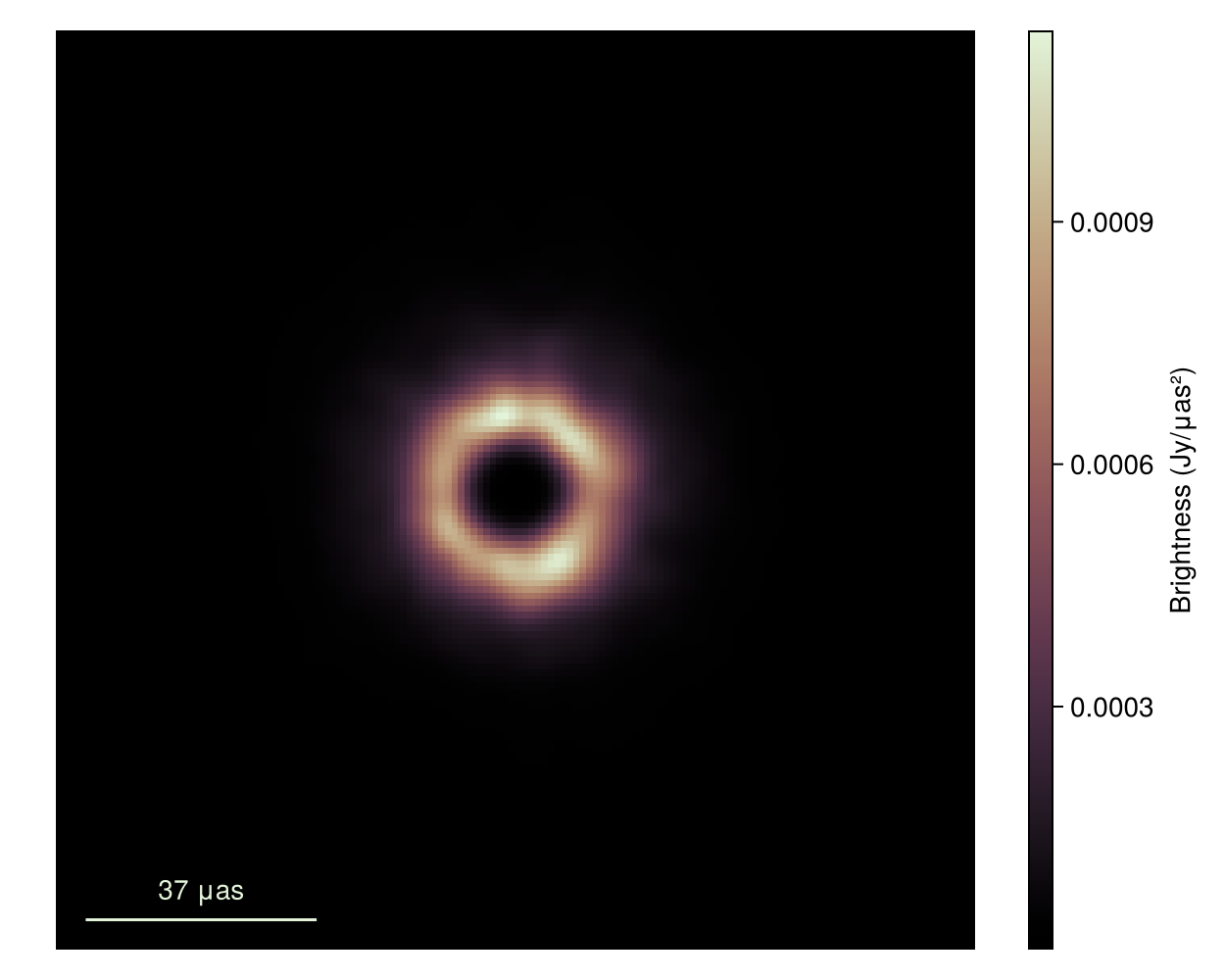
Reconstructing the Image
To find the image we will demonstrate two methods:
Optimization to find the MAP (fast but often a poor estimator)
Sampling to find the posterior (slow but provides a substantially better estimator)
For optimization we will use the Optimization.jl package and the LBFGS optimizer. To use this we use the comrade_opt function
using Optimization, OptimizationLBFGSB
xopt, sol = comrade_opt(
    post, LBFGSB();
    initial_params = xrand, maxiters = 2000, g_tol = 1.0e0
);
First we will evaluate our fit by plotting the residuals
res = residuals(post, xopt);
fig = plotfields(res[1], :uvdist, :res);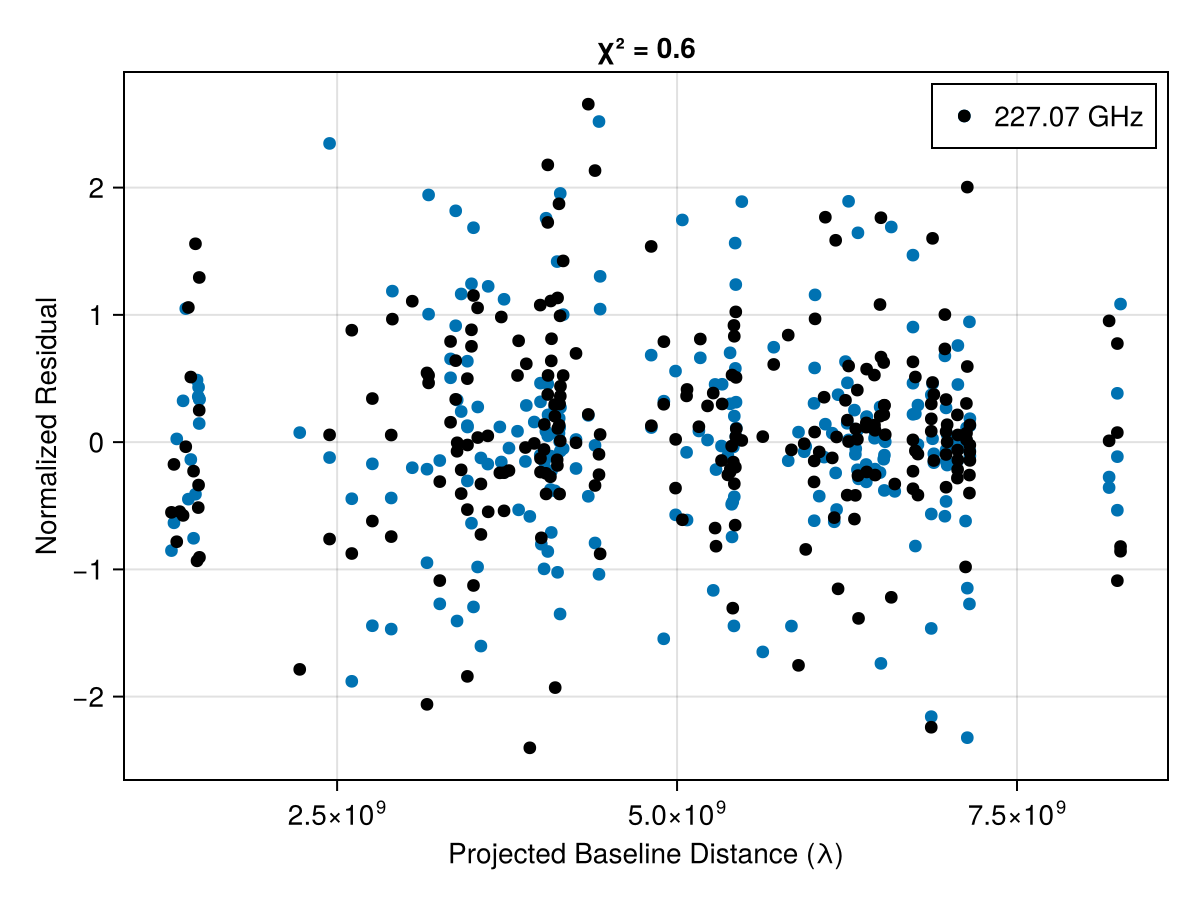
These residuals suggest that we are substantially overfitting the data. This is a common side effect of MAP imaging. As a result if we plot the image we see that there is substantial high-frequency structure in the image that isn't supported by the data.
fig = imageviz(intensitymap(skymodel(post, xopt), gpl), figure = (; resolution = (500, 400)));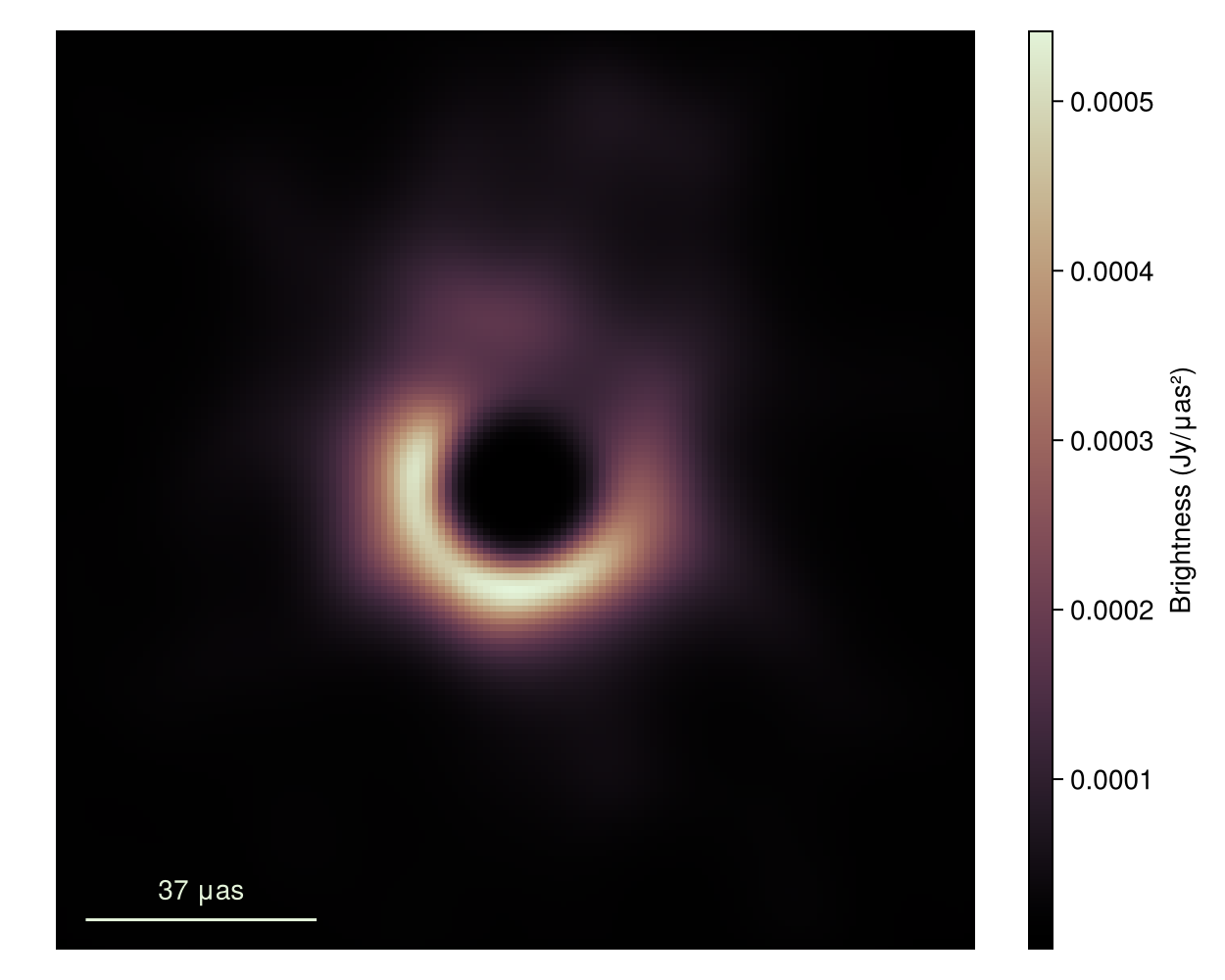
To improve our results we will now move to Posterior sampling. This is the main method we recommend for all inference problems in Comrade. While it is slower the results are often substantially better. To sample we will use the AdvancedHMC package.
using AdvancedHMC
chain = sample(rng, post, NUTS(0.8), 700; n_adapts = 500, progress = false, initial_params = xopt);
[ Info: Found initial step size 0.00078125chain = load_samples(out) We then remove the adaptation/warmup phase from our chain
chain = chain[501:end]PosteriorSamples
Samples size: (200,)
sampler used: AHMC
Mean
┌───────────────────────────────────────────────────────────────────────────────
│ sky ⋯
│ @NamedTuple{c::@NamedTuple{params::Matrix{Float64}, hyperparams::Float64}, σ ⋯
├───────────────────────────────────────────────────────────────────────────────
│ (c = (params = [0.00106496 0.00663816 … -0.0528562 -0.072825; -0.00103937 -0 ⋯
└───────────────────────────────────────────────────────────────────────────────
2 columns omitted
Std. Dev.
┌───────────────────────────────────────────────────────────────────────────────
│ sky ⋯
│ @NamedTuple{c::@NamedTuple{params::Matrix{Float64}, hyperparams::Float64}, σ ⋯
├───────────────────────────────────────────────────────────────────────────────
│ (c = (params = [0.495995 0.558688 … 0.536472 0.559008; 0.515091 0.706627 … 0 ⋯
└───────────────────────────────────────────────────────────────────────────────
2 columns omittedWarning
This should be run for 4-5x more steps to properly estimate expectations of the posterior
Now lets plot the mean image and standard deviation images. To do this we first clip the first 250 MCMC steps since that is during tuning and so the posterior is not sampling from the correct sitesary distribution.
using StatsBase
msamples = skymodel.(Ref(post), chain[begin:5:end]);
WARNING: using StatsBase.residuals in module ##225 conflicts with an existing identifier.The mean image is then given by
imgs = intensitymap.(msamples, Ref(gpl))
fig = imageviz(mean(imgs), size = (400, 300));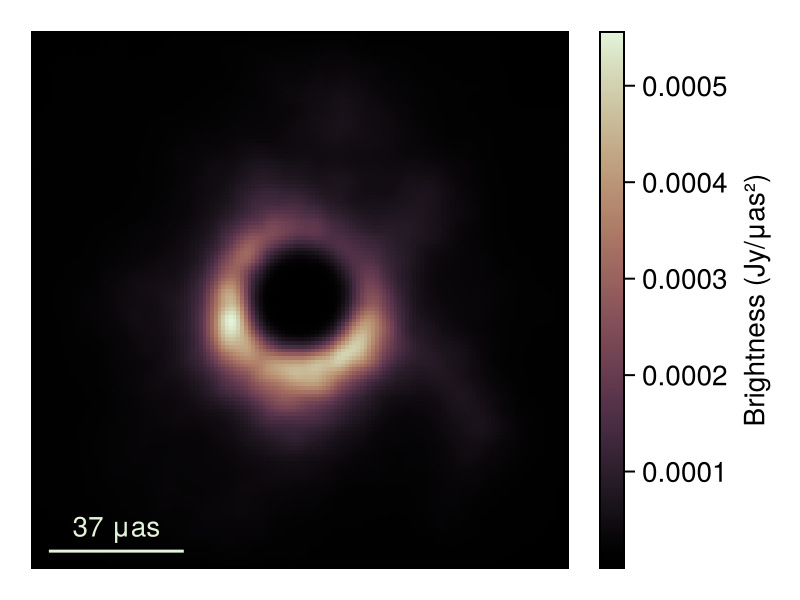
fig = imageviz(std(imgs), colormap = :batlow, size = (400, 300));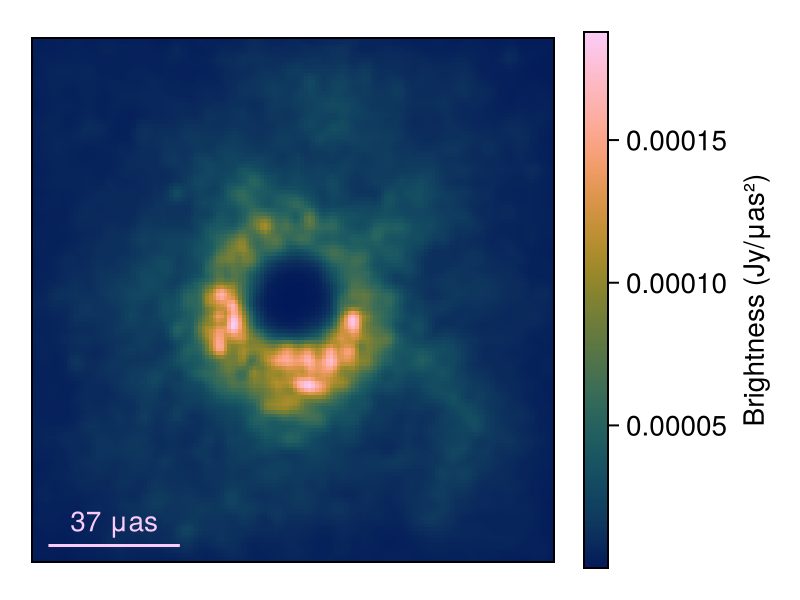
Finally, let's take a look at some of the ring parameters
figd = Figure(; resolution = (650, 200));
p1 = density(figd[1, 1], rad2μas(chain.sky.r) * 2, axis = (xlabel = "Ring Pwr Law Transition (μas)",))
p2 = density(figd[1, 2], chain.sky.ain, axis = (xlabel = "Inner Radial Index",))
p3 = density(figd[1, 3], chain.sky.aout, axis = (xlabel = "Outer Radial Index",))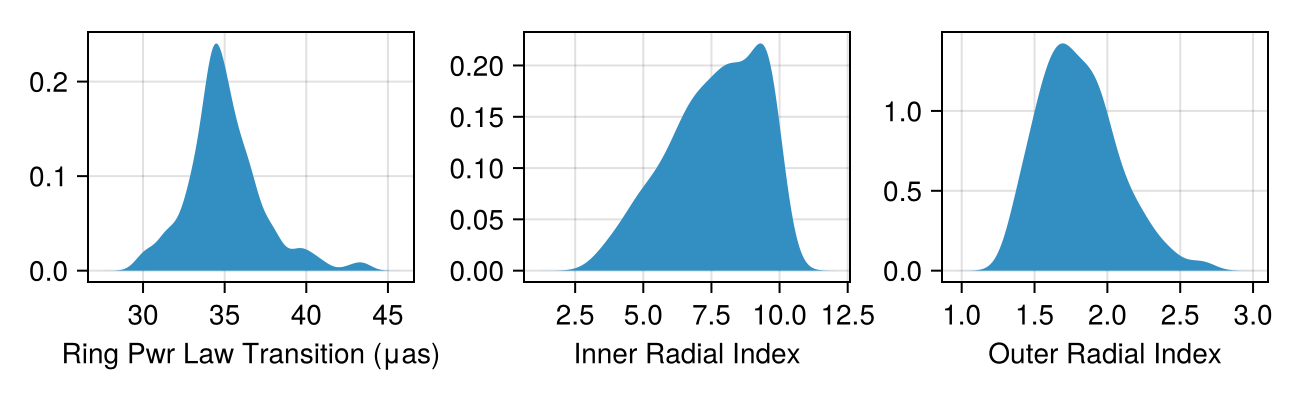
Now let's check the residuals using draws from the posterior
fig = Figure(; size = (600, 400))
resch = residuals(post, chain[end])
ax, = plotfields!(fig[1, 1], resch[1], :uvdist, :res, scatter_kwargs = (; label = "MAP", color = :blue, colorim = :red, marker = :circle), legend = false)
for s in sample(chain, 10)
    baselineplot!(ax, residuals(post, s)[1], :uvdist, :res, alpha = 0.2, label = "Draw")
end
axislegend(ax, merge = true)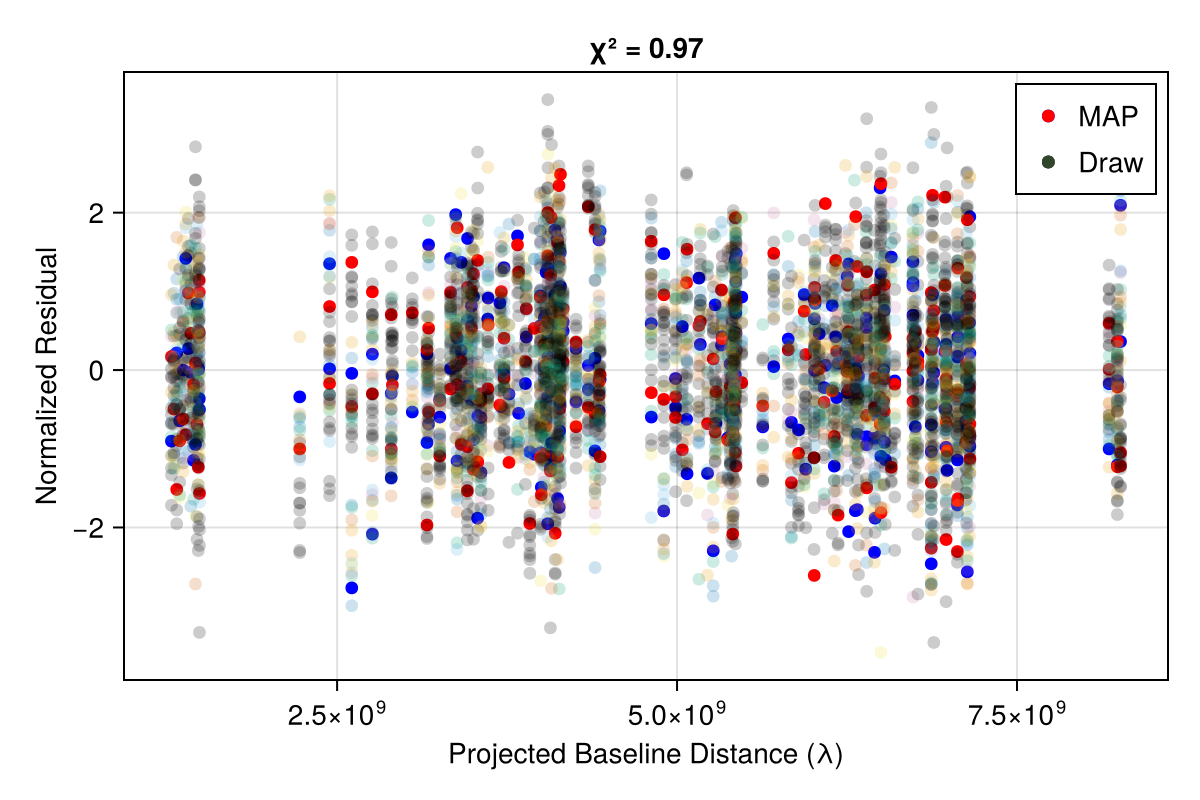
This page was generated using Literate.jl.